FAQ: You’re Right to Ask
Change brings questions — and that’s a good thing.
EcoPark SF is built on transparency, care, and community input.
This page answers the most common questions about how and why we’re reimagining the San Francisco Zoo into a place where people, animals, and nature thrive together.
Why Prioritize This When San Francisco Has Bigger Problems?
It’s a fair question. San Francisco is facing real crises — homelessness, affordability, and addiction among them. Many residents are struggling, and it’s natural to wonder:
Why invest in transforming the zoo when people are hurting?
The honest answer is that the EcoPark isn’t a distraction from those problems — it’s part of the long-term solution.
-
The EcoPark isn’t just for animals or tourists. It’s for people — for families who need free, safe public space; for students who deserve inspiring science education; for youth who want green jobs and hope for the future.
Cities heal when their public spaces heal. When we invest in parks, schools, and civic gathering places, we create connection — something our city desperately needs right now.
-
The EcoPark will generate hundreds of green construction and restoration jobs, and long-term careers in education, conservation, and hospitality.
Construction and trades jobs during the build phase
Permanent positions in science, climate education, and community programming
Paid internships and youth workforce pipelines through the Climate & Action Center
This isn’t just an environmental project — it’s an economic development project rooted in justice and inclusion.
-
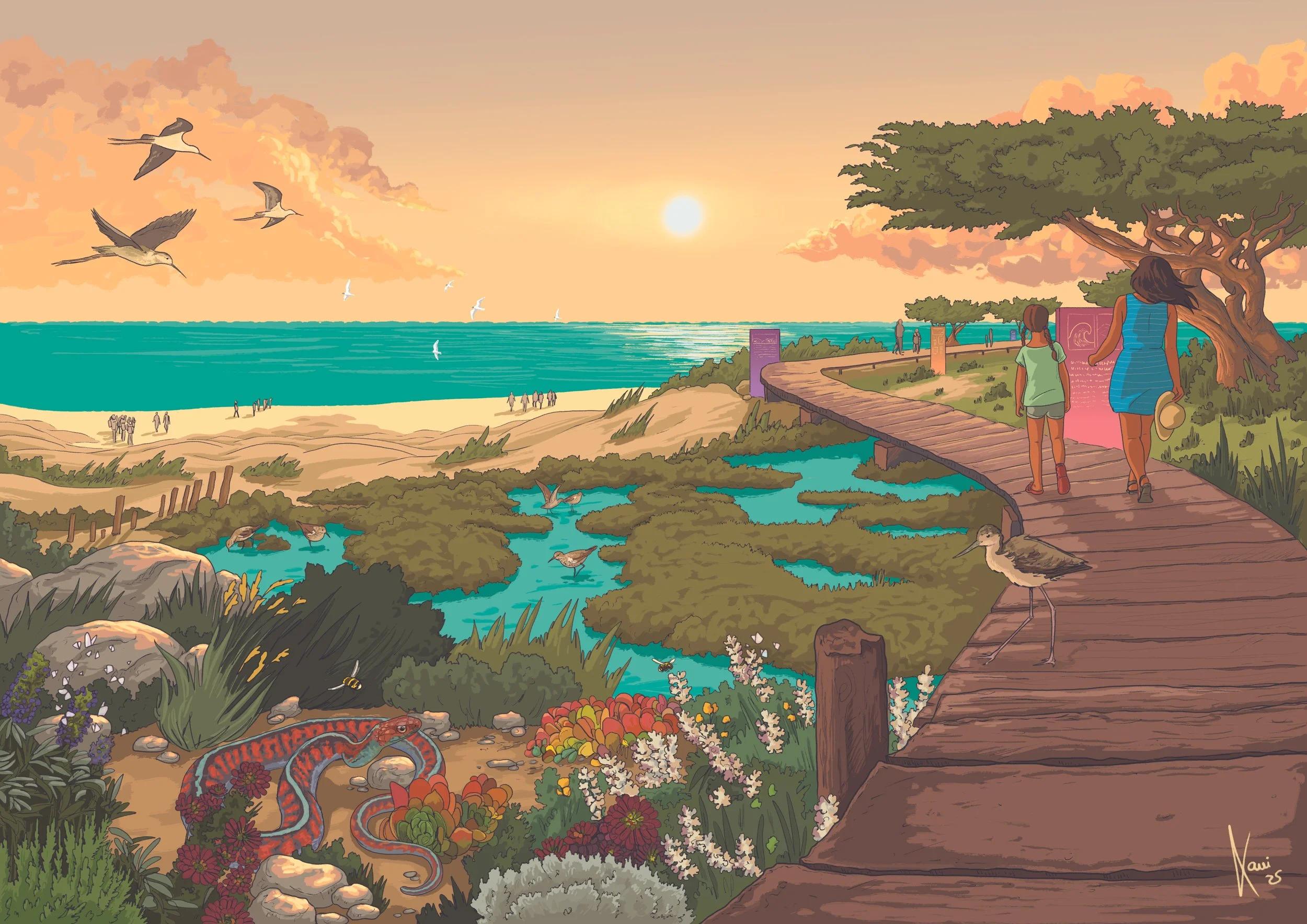
The current zoo site is one of the city’s most vulnerable locations. Without action, sea-level rise, storm surge, and erosion threaten public infrastructure and nearby neighborhoods.
The EcoPark’s Living Edge—20 acres of restored coastal habitat—acts as a natural flood defense system, saving the city from future damage costs and protecting property, roads, and homes.In other words: doing nothing is far more expensive.
-
Access to green, restorative public space has measurable impacts on community well-being.
Every EcoPark zone — from the Ocean Edge Playground to the WonderSphere — offers nature-based education, physical activity, and creative exploration.
For families who can’t afford private recreation or travel, this will be one of the few places in San Francisco where wonder is free. -
Our city has always been a global symbol of imagination, innovation, and compassion. Transforming a 20th-century zoo into a 21st-century EcoPark is more than a construction project — it’s a statement:
We can build a city that takes care of people and the planet at the same time.
The EcoPark doesn’t compete with social progress — it complements it.
It’s proof that a city can solve multiple problems at once: climate adaptation, education equity, mental health, and civic renewal.
More FAQs
-
The EcoPark will be built in phases, allowing public and private partners to invest strategically over time.
Phase 1 (Foundations + Transition): $75–100 million
Focus: animal relocation, habitat restoration, and construction of The Living Edge (climate buffer zone) and Ocean Action Lab.Phase 2 (Education + Community Zones): $100–125 million
Focus: WonderSphere, Climate & Action Center renovation, and outdoor play and learning environments.Phase 3 (Full Expansion): $75 million
Focus: The Farm, Hidden Worlds, and long-term regenerative infrastructure.
Total estimated investment: $250–300 million
At conservative growth rates (2–3% annually), the EcoPark could generate $900 million to $1.2 billion in combined economic benefit and cost avoidance over its first decade — far exceeding its initial capital investment.
-
EcoPark SF is designed to attract public–private partnerships, philanthropy, and innovation funding.
San Francisco is home to people and organizations that invest in bold ideas with civic and global impact. As support grows, so will the coalition of donors, educators, and everyday citizens making it possible. -
Much of the current zoo was built during the WPA era and no longer meets modern safety, accessibility, or sustainability standards. Most of these outdated structures will be demolished and replaced with restored landscapes and new, climate-resilient facilities.
Only historically significant buildings, such as the Mother’s Building, will be preserved and renewed through sustainable design.
Former animal enclosures will be reimagined as classrooms, gardens, wetlands, and research labs, while outdated infrastructure will give way to living systems — wetlands for stormwater filtration, solar microgrids, and green roofs that double as habitat.
This adaptive transformation honors the site’s history while clearing space for a resilient, regenerative future.
-
Transitioning away from captivity is a multi-year, humane process guided by veterinarians, sanctuary professionals, and wildlife agencies.
Natural attrition will reduce the zoo’s population over time — many animals are older and will live out their lives in peace under professional care.
Relocation partnerships with accredited sanctuaries, rehabilitation centers, and AZA facilities will ensure every animal’s welfare is prioritized.
No new exotic animals will be brought to the site. As animals are relocated, their former enclosures will be transformed into new EcoPark zones.
This thoughtful approach mirrors transitions at the Buenos Aires Ecopark and other international models, demonstrating that compassionate transformation is both achievable and ethical.
-
A 10–12 year plan beginning with:
Years 1–3: Planning, fundraising, initial habitat restoration, and animal relocation.
Years 3–6: Launch of The Living Edge and Ocean Action Lab, pilot education programs, and community engagement.
Years 6–10: Expansion into new zones, full public programming, and operational integration.
Each milestone will demonstrate measurable progress — ecological, financial, and educational — building public confidence along the way.
-
The EcoPark is designed to be a civic project, not a private one.
Public workshops will shape design and programming.
Community advisory boards will guide partnerships with schools, environmental justice groups, and artists.
Citizen science programs will invite residents to participate directly in data collection, wildlife monitoring, and restoration work.
This isn’t just a park — it’s a movement powered by the people of San Francisco.